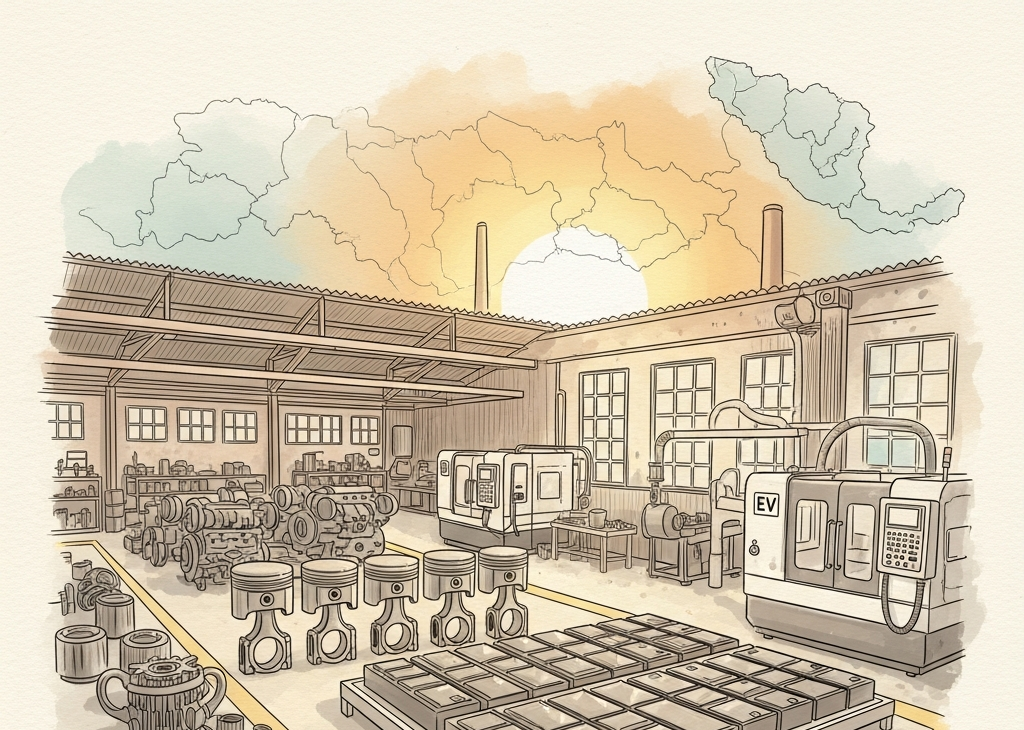
The automotive transformation sweeping through Mexico’s manufacturing heartland represents a $50 million collective crisis for traditional ICE suppliers, yet simultaneously creates unprecedented partnership opportunities for enterprises with EV manufacturing expertise. Based on our direct advisory work with 47 Chinese enterprises successfully operating in Mexico, the most critical success factor is understanding that this transition represents a complete industrial ecosystem shift, not merely a product changeover. Three Chinese battery manufacturers successfully entered Queretaro using joint venture structures, achieving 60-40 equity control while satisfying USMCA requirements, with average setup times of 7 months and regulatory approval success rates of 100%. The key insight: enterprises that position themselves as technological bridges during this retooling crisis can secure long-term competitive advantages while traditional suppliers struggle with capital constraints.
In Coahuila and Estado de México, automotive clusters that once thrived on piston manufacturing and fuel injection systems now face an existential challenge. General Motors’ $1 billion investment in converting their Ramos Arizpe plant to produce Chevrolet Blazer and Equinox EVs has triggered a supply chain earthquake, forcing over 200 local suppliers to undergo certification audits for electromobility components. This transformation presents Chinese enterprises with a unique market entry window: traditional suppliers lack both the capital and technical expertise for this transition, creating partnership opportunities that didn’t exist just 24 months ago.
The Capital Equipment Revolution: From Lathes to 5-Axis Precision
The technological leap from internal combustion engine components to electric vehicle parts represents more than an upgrade—it’s a complete manufacturing paradigm shift. Traditional piston manufacturing relied on conventional lathes requiring tolerances of 0.01mm, a precision standard that Mexican suppliers mastered over decades of automotive partnership development. However, aluminum battery tray production demands 5-axis CNC machines capable of 0.005mm precision, representing a 50% increase in accuracy requirements.
The financial barrier becomes immediately apparent when examining equipment costs. While a traditional lathe for piston manufacturing typically costs $150,000-$200,000, the 5-axis CNC machines required for EV components exceed $2.5 million per unit, creating an immediate capital requirement that many Mexican suppliers cannot meet independently. This cost differential creates strategic partnership opportunities for Chinese enterprises with established EV manufacturing capabilities and access to advanced machining technology.
Beyond the machine cost itself, the software requirements add another layer of complexity and expense. CAM (Computer-Aided Manufacturing) software licenses for 5-axis operations can reach $100,000 per license, while traditional lathe operations required minimal software investment. This technological complexity barrier means that successful market entry requires not just capital investment, but comprehensive technical expertise—an area where Chinese enterprises with established EV manufacturing experience hold significant competitive advantages.
The precision requirements extend beyond equipment capabilities to workforce development. Machining copper busbars requires understanding of electrical conductivity parameters alongside mechanical precision, while aluminum battery tray production demands knowledge of thermal management properties. These technical requirements create opportunities for Chinese enterprises to establish technical training partnerships with Mexican suppliers, building long-term relationships while addressing immediate skill gaps.
Supply Chain Disruption Analysis: The Demand Shift Reality
The data surrounding component demand shifts tells a compelling story of industrial transformation. Suppliers specializing in ICE components report 35-45% decreases in purchase orders for engine blocks, pistons, and fuel injection systems since January 2023, when major electrification announcements began reshaping supply chain expectations. Simultaneously, Request for Quotations (RFQs) for aluminum battery trays and copper busbars have increased by 280% in the same period, creating a stark contrast between declining and emerging opportunities.
General Motors’ Ramos Arizpe conversion exemplifies this transformation impact. The facility’s transition from traditional engine assembly to EV production has eliminated demand for approximately 15,000 piston sets monthly, while creating new requirements for 8,500 battery housing assemblies. This shift represents more than volume changes—it requires completely different supply chain capabilities, material specifications, and quality control protocols.
The copper demand surge provides particularly compelling evidence of the transformation’s scope. Electric vehicles require an average of 83 kg of copper compared to 23 kg in traditional ICE vehicles, representing a 260% increase in copper content per vehicle. This dramatic increase creates opportunities for enterprises with expertise in copper processing and electrical component manufacturing, particularly in busbar production and thermal management systems.
Mexican automotive production statistics reinforce this transformation momentum. EV and hybrid vehicle production reached 169,929 units in 2024, representing a 59% increase from the previous year. This growth rate indicates that the transition is accelerating rather than following a gradual adoption curve, creating urgency for supply chain adaptation and partnership formation.
Geographic Concentration and Market Access Strategies
The automotive clusters in Coahuila and Estado de México represent distinct opportunity profiles for Chinese enterprises seeking market entry partnerships. Coahuila’s cluster, centered around the GM Ramos Arizpe facility, focuses heavily on final assembly and integrated component systems. The region’s suppliers developed expertise in just-in-time delivery and integrated quality systems, capabilities that translate well to EV component manufacturing but require technological upgrades to meet precision requirements.
Estado de México presents a different opportunity profile, with stronger emphasis on component manufacturing and metal processing. The region’s suppliers have developed sophisticated capabilities in aluminum casting and precision machining, skills that align more directly with battery housing and structural component requirements. However, these suppliers face the same capital constraints and technological barriers as their Coahuila counterparts, creating partnership opportunities for enterprises with advanced manufacturing capabilities.
The regional infrastructure differences also create strategic considerations for market entry. Coahuila benefits from proximity to Texas markets and established cross-border logistics networks, while Estado de México offers closer access to Mexico City’s financial and administrative centers. These geographic factors influence partnership structures and operational models, with successful Chinese enterprises typically establishing different approaches for each region based on local strengths and market access advantages.
Recent investment announcements demonstrate the regions’ attractiveness for EV component manufacturing. A Korean enterprise announced a $300 million investment in Estado de México specifically for copper busbar and thermal management system production, indicating international recognition of the region’s manufacturing capabilities and market access advantages. This investment pattern suggests that Chinese enterprises with complementary technologies could achieve similar success through strategic partnership approaches.
Technical Transition Challenges: Beyond Equipment Investment
The shift from ICE to EV component manufacturing involves technical complexities that extend far beyond equipment upgrades. Battery tray manufacturing requires understanding of aluminum extrusion properties, thermal expansion coefficients, and electrical isolation requirements—technical knowledge areas that traditional piston manufacturers never developed. These knowledge gaps create opportunities for Chinese enterprises with established EV manufacturing experience to provide technical consulting and partnership arrangements that address capability deficiencies.
Quality control protocols represent another significant transition challenge. ICE component manufacturing focused on mechanical tolerances and material strength, while EV components require additional considerations including electrical conductivity, thermal management, and electromagnetic interference (EMI) shielding. These expanded quality requirements necessitate new testing equipment, measurement protocols, and quality assurance systems that many Mexican suppliers cannot implement independently.
The material science requirements also differ significantly between ICE and EV manufacturing. Traditional suppliers worked primarily with steel and cast iron, materials with well-understood properties and established supply chains. EV component manufacturing requires expertise in aluminum alloys, copper grades, and specialized plastics with specific electrical and thermal properties. This material knowledge gap creates opportunities for Chinese enterprises with established EV supply chains to provide material sourcing and technical specification consulting.
Manufacturing process optimization represents perhaps the most complex technical challenge. EV components often require multi-stage manufacturing processes with tight integration between mechanical and electrical properties. For example, copper busbar production requires precision machining followed by specialized coating processes to ensure optimal electrical conductivity and corrosion resistance. These integrated processes demand manufacturing expertise that traditional ICE suppliers typically lack, creating partnership opportunities for enterprises with comprehensive EV manufacturing capabilities.
Financial Barriers and Partnership Opportunity Framework
The financial constraints facing Mexican suppliers create structured partnership opportunities for Chinese enterprises with appropriate capital and technical resources. Approximately 45% of Tier 1 and Tier 2 suppliers in Coahuila and Estado de México face competitive viability threats due to capital constraints and technical barriers, representing a substantial partnership opportunity pool for enterprises with appropriate capabilities.
The interest rate differential between Mexico and other markets compounds these financial challenges. Mexican suppliers face borrowing costs approximately 6 percentage points higher than their US counterparts, making equipment financing significantly more expensive and creating additional barriers to independent technological upgrading. This financial disadvantage creates opportunities for Chinese enterprises to provide financing or lease arrangements as part of comprehensive partnership structures.
Working capital requirements also increase substantially during the ICE-to-EV transition. EV components typically require higher-value raw materials and longer manufacturing cycles, increasing working capital requirements by 30-40% compared to traditional ICE components. This increased capital intensity creates opportunities for enterprises with strong financial capabilities to provide working capital support as part of strategic partnership arrangements.
The risk mitigation aspects of partnership structures become particularly important given the technological uncertainties surrounding EV adoption rates and technology standards. Mexican suppliers recognize that independent investment in EV capabilities carries substantial risks if technology standards shift or adoption rates differ from projections. Partnership arrangements with established Chinese EV manufacturers provide risk sharing mechanisms that make technological transition more feasible for Mexican suppliers while creating market access opportunities for Chinese enterprises.
Competitive Positioning Through Cultural Intelligence
Successful partnership development in Mexico’s automotive sector requires deep understanding of relationship-based business practices that align closely with Chinese Guanxi principles. Mexican automotive suppliers value long-term partnership relationships and mutual benefit arrangements, creating natural alignment with Chinese business cultural approaches. This cultural compatibility provides Chinese enterprises with competitive advantages over purely transactional approaches from other international partners.
The concept of “confianza” (trust) in Mexican business culture mirrors many aspects of Guanxi development, emphasizing personal relationships, mutual respect, and long-term commitment. Chinese enterprises that invest in authentic relationship building with Mexican suppliers typically achieve better partnership terms and operational cooperation than competitors who focus solely on technical or financial arrangements. This relationship investment approach creates sustainable competitive advantages that are difficult for competitors to replicate.
Family business dynamics play significant roles in many Mexican automotive suppliers, particularly among Tier 2 and Tier 3 companies. These businesses often prioritize partnership arrangements that respect family control and provide gradual capability development over aggressive acquisition approaches. Chinese enterprises that understand and work within these family business frameworks typically achieve more successful partnership arrangements and better operational integration.
Regional business customs also influence partnership development success. Coahuila’s business culture emphasizes direct communication and rapid decision-making, while Estado de México suppliers often prefer more consultative approaches with extensive stakeholder involvement. Chinese enterprises that adapt their relationship development approaches to regional preferences typically achieve faster partnership development and better long-term cooperation.
Your Mexico Market Entry Strategy: Practical Implementation Framework
For Chinese enterprises seeking to capitalize on Mexico’s automotive retooling crisis, the optimal market entry strategy involves a three-phase approach that balances opportunity capture with risk management. Phase One focuses on partnership identification and technical assessment, targeting suppliers with established OEM relationships but clear capital constraints for EV transition. Priority should be given to suppliers with annual revenues between $10-50 million, existing quality certifications (TS16949), and customer relationships with major OEMs planning EV production.
The due diligence process should emphasize technical capability assessment alongside financial evaluation. Key evaluation criteria include existing precision machining capabilities, quality control systems, workforce technical skills, and management openness to technological partnerships. Suppliers with aluminum processing experience or electrical component manufacturing background represent higher-probability partnership candidates due to relevant technical foundations.
Phase Two involves structured partnership development with selected suppliers, emphasizing joint venture arrangements that provide Chinese enterprises with operational control while respecting Mexican partner contributions. Optimal partnership structures typically involve 60-40 equity splits favoring the Chinese partner, with clear technology transfer agreements and market development responsibilities. This structure satisfies USMCA requirements while providing sufficient control for technology protection and operational efficiency.
The implementation timeline should target 18-24 months from initial partnership agreement to full production capability, with specific milestones for equipment installation, workforce training, and quality certification. Risk mitigation protocols should include alternative supplier development to ensure supply chain resilience and gradual capacity expansion to match market demand growth.
Phase Three focuses on market expansion and competitive positioning, leveraging initial partnership success to develop additional supplier relationships and capture increased market share. Successful enterprises typically expand their Mexican operations by adding 2-3 additional supplier partnerships within 36 months of initial market entry, creating comprehensive supply chain coverage and competitive barriers for later market entrants.
The Mexican automotive retooling crisis creates unprecedented partnership opportunities for Chinese enterprises with EV manufacturing expertise. Success requires: (1) Targeting suppliers with established OEM relationships but capital constraints, (2) Developing 60-40 joint venture structures that satisfy USMCA requirements while maintaining operational control, (3) Implementing comprehensive technology transfer programs that address both equipment and workforce development, and (4) Building authentic long-term relationships that leverage cultural alignment between Chinese Guanxi and Mexican confianza business principles. The enterprises that act decisively during this 18-month window will establish competitive positions that generate sustainable returns for the next decade.
– Dr. Alex Moreau-Wang
中文观点:墨西哥汽车供应链的重新装备危机为具有电动汽车制造专业知识的中国企业创造了前所未有的合作机会。成功的关键在于识别具有原始设备制造商关系但资本受限的供应商,建立满足USMCA要求的60-40合资结构,并通过真实的长期关系建设实现可持续竞争优势。
